
My Type is a Feature, Not a Bug
dancer chick seeking narcissists

The conventional wisdom goes something like this: if you’re a girl who keeps falling for the Wrong Kind of Guy™, you should go get therapy with the goal of changing whom you fall for, while learning to deeply love yourself, as if a lack of self love is always the issue.
This advice is absolute garbage.
The underlying premise here is that your attraction is a malfunction you’re supposed to debug. I don’t think this is always true. Sometimes, it’s worth digging into bad patterns of behavior and fixing them. Other times, maybe those desires are actually ok??
More so, changing what you want can be ineffective at best, damaging at worst, especially if you end up repressing your true desires instead of actually engaging with them and learning from them. It takes introspection to figure out which of your desires actually hurt you or others and which ones just look alarming to other people. And even when some preferences carry risk, there are ways to mitigate the risks.
I’ve become substantially happier since deciding to pursue what I want honestly, instead of worrying about judgment.
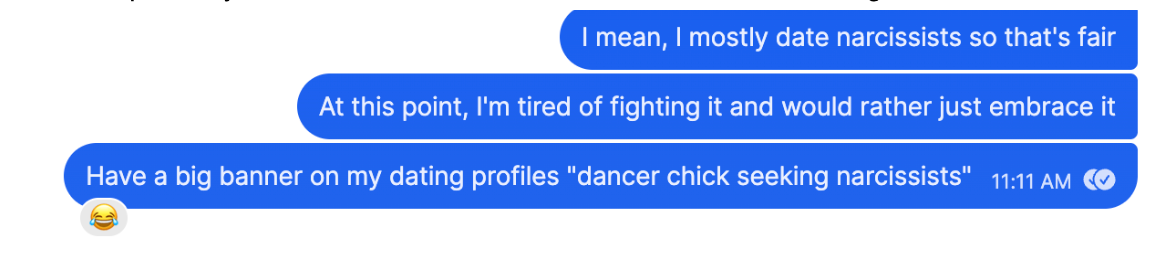
Case in point, my recent conversation here with a friend of mine over Signal:
Wounds and preferences are different things
Some of what you’re attracted to comes from old damage, which people sometimes refer to as “emotional wounds”. These are probably worth paying attention to. In my early teens I kept dating people with low empathy, because I was used to that from my childhood. I dated a string of people with sociopathic tendencies. Ask me sometime about the guy who begged me to let him waterboard me on every date and eventually broke up with me after a year because I kept refusing to do that particular thing with him.
These relationships consistently made me unhappy, and I learned to screen for fellow high empathy people instead. Now, as soon as I see signs of this low-empathy trait, I lose physical attraction to that person pretty suddenly. But this came from the learned knowledge that these people genuinely make me unhappy, not from prescribed ideas about what’s supposed to be good for me. I didn’t decide one day “hey I’m going to stop being attracted to people like this.” I just remembered the pain/discomfort/bad feels from people like that and my brain did the work for me.
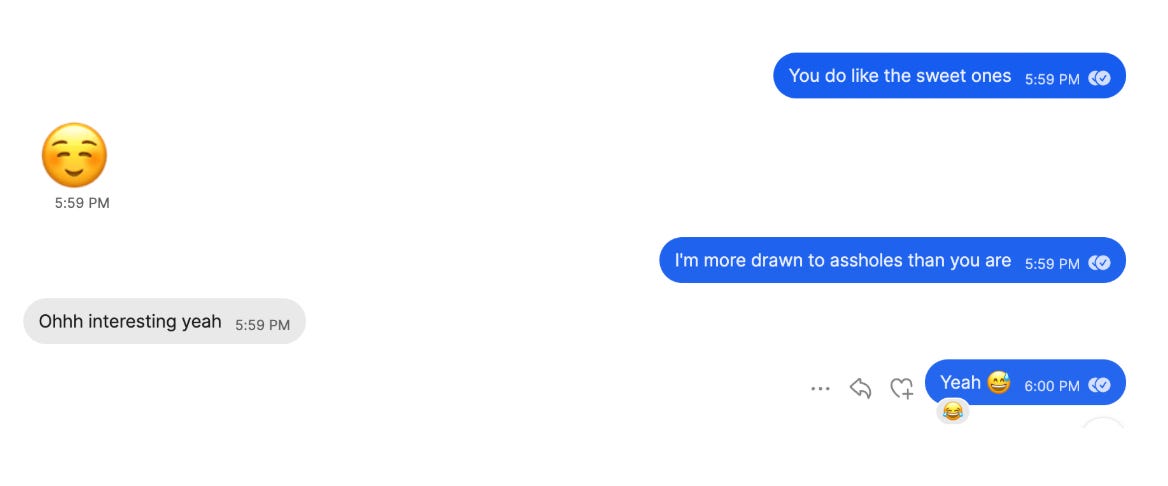
Most of what I’m attracted to does not come from emotional wounds. It’s my authentic taste. For example, I really like assholes. They make me laugh and light up. And why is this a problem? Everyone deserves love, assholes too. I’m happy to be someone who can offer genuine attraction/love/care to people who can be jerks (as long as they have genuine empathy for other people as well).
Trying to therapy your way out of a real preference doesn’t make you healthier. It just makes you repressed and miserable.
The actual skill is learning your own habits well enough to know what feels good to you, instead of cosplaying somebody else’s idea of what a healthy relationship is supposed to look like.
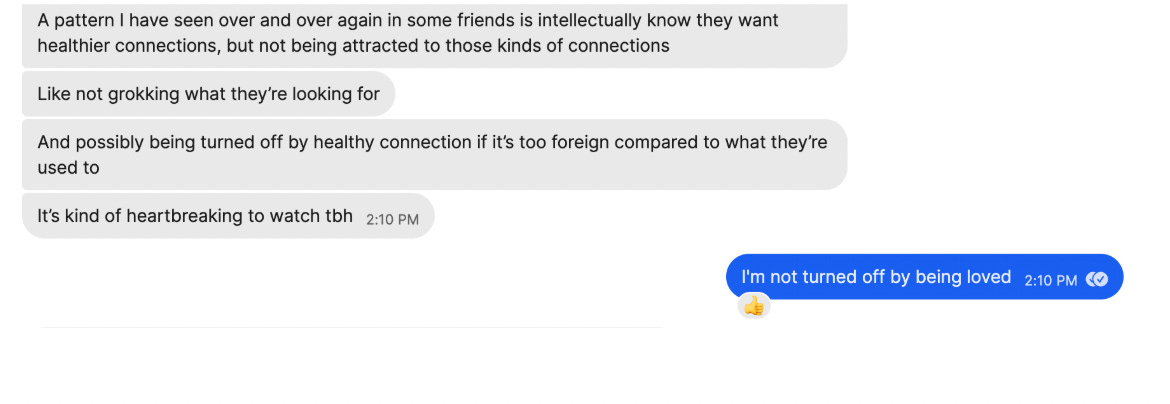
This conversation with a friend of mine highlights the difference:
You can’t fake normal forever
The standard healthy relationship, the one that works great for the average person, would feel awful for me to live inside. I’m a weird, quirky person and I require a non-standard relationship to be happy.
For most quirky/weird people who are like me, the advice to modify whom you like is harmful to both to the person taking the advice and to the people they date.
If you’re an unusual person, maybe with some tendencies toward mania or anxiety, and you repress all of that to make yourself palatable to a normie partner, there’s a chance that you’ve built a ticking time bomb that will eventually explode, spectacularly, hurting everyone involved.
I feel quite lucky that the normie people whom I dated didn’t interest me enough, and that I turned down their marriage proposals (twice) in favor of a much more exciting and enticing life partner that fit my exact tastes and preferences and that isn’t surprised by the darker parts of my psyche.
People sort by how weird they are
Although there are notable exceptions, from what I’ve seen, frequently people self-sort based on eccentricity and level of mental illness in their relationships, just as they tend to do based on physical attractiveness, intelligence, and a number of other traits. (Correct me if you have more/better data and I’m wrong here!)
I don’t think this is a bad thing! I want someone deeply, highly compatible to me, not to the version of myself that I’m trying to conform myself to based on what I think people will want or what healthy is supposed to look like.
I don’t just want a partner who is willing to tolerate/overlook my occasional manic tendencies. I want someone who actively was looking for someone highly ambitious, energetic, and excited about life and loves that part of me deeply.
The demand side, or: who actually wants this
Despite my friend Standard Deviant recently saying, “who would be into that?” while we were chatting at Manifest, there are actually A LOT of people who are specifically into this.
The manic pixie dream girl trope exists for a reason, after all.
Also, my friends backed me up on this, so there :P
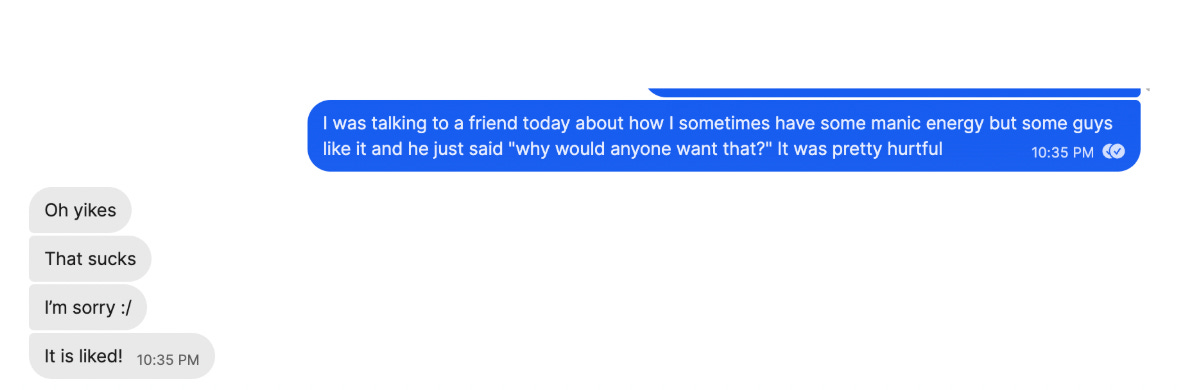
I have found a very large number of men (namely the last six guys who I have dated) who have told me some version of “It’s not intentional, but I seem to only date manic depressive girls.” Notably, one of my exes that I am still close friends with texted me this while we were catching up:

Personally, I think there are many valid reasons to prefer dating manic depressive girls. The highs are actually very very good. Have you ever had sex while manic, or with someone while they’re happily manic? During mania, there’s a lot of energy and excitement and many people tend to be quite hypersexual, uninhibited, and open to trying new things in these states.
I asked my husband about this and he said some version of “If you want a girl who is hypersexual and has a 40-hour fuckfest with you all weekend, or who has sex with you 3 times a day while you travel all over Asia, well… you’ve got to be prepared to also do a bit of work steadying them during the lows as well.”
TLDR the highs are really fun and if you’re drawn to this, maybe you should just accept this and go for this.
On my side, even though I stamped out my attraction to sociopathic people successfully and am no longer into that, I still remain highly attracted to people with mild narcissist traits. See my previous articles where I mention that I most only date exited founders, VCs, and professors. (and once I have found someone who is all 3 and that is particularly delicious for me).
After a decade of trying to change my patterns of attraction unsuccessfully around this in particular, I realized that this is very core to how attraction works for me, and I don’t actually want to change this. No other dynamics are anywhere near as satisfying for me, and I want to feel this kind of intensity in my important relationships.
The supply side, or: what I actually want
My most passionate and quite frankly, fun, and intense dynamics are with people with narcissist tendencies who tend to like girls when they’re manic. Instead of thinking “oh this seems bad/toxic and I should avoid this dynamic”, perhaps there is a better way. Maybe we can find healthy ways to enjoy these dynamics, while mitigating the potential harms.
Risk Mitigation Techniques
I haven’t always been good at mitigating this harm, but I’ve been learning from my mistakes. I also have some friends who are spectacularly good at mitigating it and are true masters of this. Here are some crowd-sourced strategies that have worked for myself and others.
I tend to overcommunicate about my patterns/tendencies and especially err on the side of sharing things I feel scared to share.
Texts from a few guys I’ve been involved with:
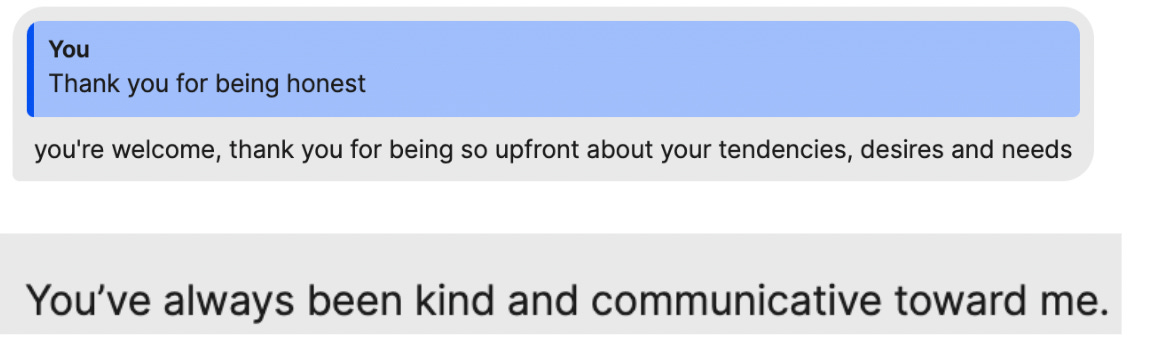
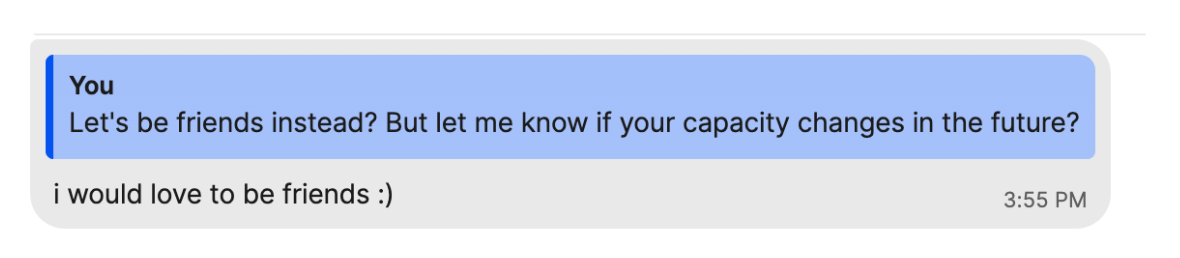
I intentionally tell people if I’m likely to get attached to them, ask them about their relationship capacity and interest in me, and back off/choose not to hook up with them if they are not available. Case in point:
I ask people if they’ve dated people with anxiety or adhd or other things like this in the past and gauge their experience levels with this. I lean in more if they have experience and are skilled at dealing with these things.
Not taking on any new partners for the first 12 months of any new relationship in order to grow deep enough roots/put enough attention into that new serious relationship. (I personally don’t do this but I’ve seen this work well for 4+ people at this point.)
One strategy that I have for basically all secondary partners is that I only see them when I’m energetic and happy, and I tend to just spend a lot of alone time when I’m low energy. I don’t get that depressed, I just get tired and want to drink tea and read books and not be bothered by anyone for a while. I tend to tell people explicitly that I need relationships with low maintenance needs (see previous posts about relationship decay rates) in order to convey that I might have less energy to hang out for a few weeks at a time and it’s not personal to them or to the relationship.
From another recent text conversation with an ex while I was talking about being manic sometimes but just taking lots of alone time when I’m tired:

Mea Culpa / Mistakes to avoid
One of my friends was chatting with me about this article as I was writing it and said:
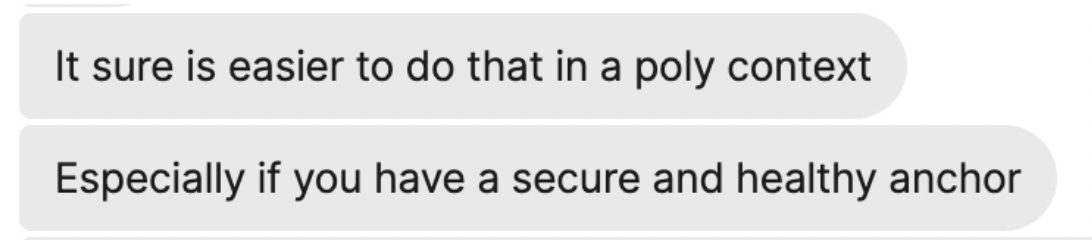
I can see what he means, but it’s also possible to make worse mistakes in a poly context. I’ve made the mistake of neglecting my primary partner and having fun, mania-fueled flings with others, giving them all the fun highs, and leaving him with only the lows. This is a bad deal and a pretty unfair way to treat your primary partner.
I also want to make clear that I’m not suggesting that people do a bunch of toxic, dangerous things. I’m just saying that self-awareness is key and that instead of repressing preferences, it’s worth understanding them at length and then figuring out the healthy ways to channel them.
In some cases, it may be that the only way to channel them is via a negotiated kink scene with very specific parameters. In other cases, it may be ok to date assholes or bipolar chicks as long as everyone is communicating well and setting clear expectations about it. You do you.
I'm curious what you find attractive about jerks/assholes/narcissists. I've heard theories like, they are bold and go after what they want (people like being desired), they aren't push overs, they are confident/assertive and status seeking. They often have a bundle of attractive traits, but it's not the cruelty itself. Maybe it's just harder to find a sweet person with the same traits as they're in higher demand.